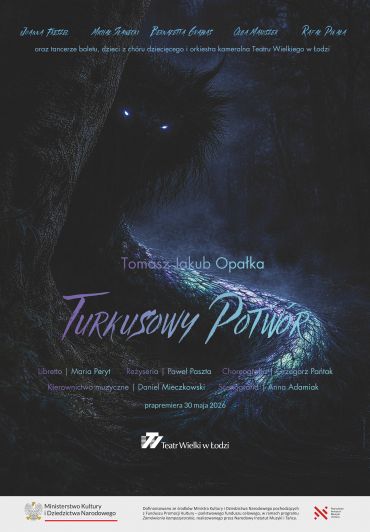
“The Blue Monster” is a chamber opera for children aged 4 and up — a musical tale based on a play by Carlo Gozzi, the Venetian master of 18th-century commedia dell’arte and the author of The Love for Three Oranges, The Green Bird, and Turandot, among others. The original libretto, written by the composer, uses Gozzi’s play as a point of departure, transporting it into a world close to the contemporary audience through a creative reinterpretation. It is inspired by the poetic story of Dardane and Taer, full of dangers and fairytale-like challenges.
This is a story about overcoming uncertainty, discovering true inner selves, and finding beauty in diversity. The themes of the production are especially important today, particularly for children and young people who, often left to their own devices, struggle to distinguish good from evil in the virtual world. The music will be composed by Tomasz Jakub Opałka.
Libretto Summary
Before humans appeared, emotions had no names and were not judged. They were forces that kept the world in balance: anger and sorrow guarded our boundaries, while joy illuminated the darkness. Yet mockery found its way into this idyllic world. One word. A broken heart. A single tear. From them, the Turquoise Monster was born.
For thousands of years, it has remained trapped in a form that is both its punishment and the curse of all those who encounter it. The Monster knows that words can wound more deeply than a knife, yet it cannot see a way out of its fate. It believes that only magic can save it, and magic demands a sacrifice: the separation of two pure-hearted people and trials in which neither courage nor strength alone will suffice. When the Monster meets a loving brother and sister, it cannot resist temptation and sets the wheel of fate in motion.
Ashka and Aaden – sister and brother living in a colourful town – do not quite fit into the rest of the world, but it is precisely because of this that they discover their power to change reality. Ashka, brave and energetic, secretly fears admitting to her own sensitivity, which she sees as a sign of weakness. She tries to reject difficult emotions, yet in fighting them she is truly fighting herself. Gradually, she learns to trust her heart and intuition, discovering the strength that lies in gentleness.
Aaden, quiet and sensitive, comes to realise that the world is not simply black and white. At first he escapes from reality, unable to face hardship, conflict, and the violence directed at him. This makes him the perfect victim – not only for the children in the town, but also for the Turquoise Monster. Trapped with no apparent escape, he discovers within himself a strength and courage he never imagined he possessed. Through action, he finds his own voice, and his devotion and compassion save everything he loves.
Before that, however, the children must confront the challenges of the world around them. When they are mocked and provoked by their peers, Ashka takes a risk and leads Aaden into the enchanted forest from which, according to legend, no one ever returns.
A storm separates the siblings in a wilderness suspended between day and night. From that moment on, nothing is as it seems. Ashka is transformed into a knight and cast into a petrified, colourless world ruled by relentless fate and time. Aaden awakens in the body of the Monster – forbidden to reveal who he truly is, forced to act and take initiative in a situation that at first appears hopeless. Between them stands the Stone Fountain – a trickster, the alter ego of the Turquoise Monster and the embodiment of its dual nature. It offers no solutions; instead, it provokes and raises new questions.
The magical world into which we descend with the children draws upon Proto-Slavic roots, symbolising the search for identity. The Rodzanice – the Slavic counterparts of the Greek Fates – weave a wreath of herbs and gifts from the forest, symbolising the inevitable passage of time and the cyclical nature of life. Mysterious creatures inspired by Slavic bestiaries, such as Tęsknica and Raróg, are not enemies but embodiments of emotions: anger, fear, and sorrow. The children learn that these emotions cannot be destroyed, only understood and accepted – and that through this understanding both they and the world may be saved.
What must happen for a world petrified by fear and mockery to breathe again? The Turquoise Monster invites reflection on the idea that struggle and destruction alone are not enough. What is needed is mindfulness, responsibility for one’s words and choices, and collective action for the good of others – sometimes even sacrifice.
All the characters emerge from this story transformed. They draw strength from one another and complete one another, though at first they do not realise it. What is a curse or burden for one character becomes the missing element of identity for another. By reconciling themselves with their emotions and making their own choices, they become fuller, richer, more colourful versions of themselves.
The Turquoise Monster is a story about the active presence of goodness within us: in our words, our actions, and the awareness and courage we discover inside ourselves. It is a tale about choice and agency. Both moving and light-hearted, filled with humour, magic, and hope, it shows that true victory is often achieved not through battle, but through pausing, looking deeper, and taking actions that can transform the world.






.remove();show_photo('../pl/ajax_photo.php', 'path=../images/photo/&photo=dsc023717.jpg&id=21207&table=photo&photo_div=war_foto21207', 'war_foto21207', event, '1120', '800','../images/photo/dsc023717.jpg');void(0);)
.remove();show_photo('../pl/ajax_photo.php', 'path=../images/photo/&photo=dsc02474.jpg&id=21208&table=photo&photo_div=war_foto21208', 'war_foto21208', event, '1159', '800','../images/photo/dsc02474.jpg');void(0);)
.remove();show_photo('../pl/ajax_photo.php', 'path=../images/photo/&photo=dsc02523.jpg&id=21209&table=photo&photo_div=war_foto21209', 'war_foto21209', event, '1120', '800','../images/photo/dsc02523.jpg');void(0);)
.remove();show_photo('../pl/ajax_photo.php', 'path=../images/photo/&photo=dsc0256332.jpg&id=21210&table=photo&photo_div=war_foto21210', 'war_foto21210', event, '1120', '800','../images/photo/dsc0256332.jpg');void(0);)
.remove();show_photo('../pl/ajax_photo.php', 'path=../images/photo/&photo=dsc02611.jpg&id=21211&table=photo&photo_div=war_foto21211', 'war_foto21211', event, '1120', '800','../images/photo/dsc02611.jpg');void(0);)
.remove();show_photo('../pl/ajax_photo.php', 'path=../images/photo/&photo=dsc0272163.jpg&id=21213&table=photo&photo_div=war_foto21213', 'war_foto21213', event, '1120', '800','../images/photo/dsc0272163.jpg');void(0);)
.remove();show_photo('../pl/ajax_photo.php', 'path=../images/photo/&photo=dsc028810.jpg&id=21214&table=photo&photo_div=war_foto21214', 'war_foto21214', event, '1120', '800','../images/photo/dsc028810.jpg');void(0);)
.remove();show_photo('../pl/ajax_photo.php', 'path=../images/photo/&photo=dsc029183.jpg&id=21215&table=photo&photo_div=war_foto21215', 'war_foto21215', event, '1120', '800','../images/photo/dsc029183.jpg');void(0);)
.remove();show_photo('../pl/ajax_photo.php', 'path=../images/photo/&photo=dsc029255.jpg&id=21216&table=photo&photo_div=war_foto21216', 'war_foto21216', event, '1120', '800','../images/photo/dsc029255.jpg');void(0);)
.remove();show_photo('../pl/ajax_photo.php', 'path=../images/photo/&photo=dsc03006.jpg&id=21219&table=photo&photo_div=war_foto21219', 'war_foto21219', event, '1120', '800','../images/photo/dsc03006.jpg');void(0);)
.remove();show_photo('../pl/ajax_photo.php', 'path=../images/photo/&photo=dsc030582.jpg&id=21220&table=photo&photo_div=war_foto21220', 'war_foto21220', event, '1120', '800','../images/photo/dsc030582.jpg');void(0);)
.remove();show_photo('../pl/ajax_photo.php', 'path=../images/photo/&photo=dsc030992.jpg&id=21221&table=photo&photo_div=war_foto21221', 'war_foto21221', event, '1120', '800','../images/photo/dsc030992.jpg');void(0);)
.remove();show_photo('../pl/ajax_photo.php', 'path=../images/photo/&photo=dsc031726.jpg&id=21222&table=photo&photo_div=war_foto21222', 'war_foto21222', event, '1120', '800','../images/photo/dsc031726.jpg');void(0);)
.remove();show_photo('../pl/ajax_photo.php', 'path=../images/photo/&photo=dsc0319446.jpg&id=21223&table=photo&photo_div=war_foto21223', 'war_foto21223', event, '1120', '800','../images/photo/dsc0319446.jpg');void(0);)
.remove();show_photo('../pl/ajax_photo.php', 'path=../images/photo/&photo=dsc03248.jpg&id=21224&table=photo&photo_div=war_foto21224', 'war_foto21224', event, '1120', '800','../images/photo/dsc03248.jpg');void(0);)
.remove();show_photo('../pl/ajax_photo.php', 'path=../images/photo/&photo=dsc03329.jpg&id=21225&table=photo&photo_div=war_foto21225', 'war_foto21225', event, '1120', '800','../images/photo/dsc03329.jpg');void(0);)
.remove();show_photo('../pl/ajax_photo.php', 'path=../images/photo/&photo=dsc03376.jpg&id=21226&table=photo&photo_div=war_foto21226', 'war_foto21226', event, '1120', '800','../images/photo/dsc03376.jpg');void(0);)
.remove();show_photo('../pl/ajax_photo.php', 'path=../images/photo/&photo=dsc034137.jpg&id=21227&table=photo&photo_div=war_foto21227', 'war_foto21227', event, '1120', '800','../images/photo/dsc034137.jpg');void(0);)